Modern Architectural Scale Model for Sales Center
Introduction
Buyers today expect more.
A brochure is not enough.
A digital tour feels distant.
They want to see the future.
They want to touch it.
That is where a Modern Architectural Scale Model for Sales Center comes in.
It is clean, sleek, and designed to impress.
In this guide, you will learn how to build and use one.
Let us begin.
What Is a Modern Architectural Scale Model for Sales Center?
It is a physical replica of a real estate project.
Placed in a sales gallery or showroom.
A Modern Architectural Scale Model focuses on clean lines and minimal details.
No cluttered landscaping.
No overly bright colors.
Instead, it uses neutral tones, simple shapes, and strategic lighting.
The goal is to highlight the architecture itself.
Buyers see the building’s form, not the decorations.
This style is perfect for contemporary condos, boutique hotels, and high‑end mixed‑use developments.
Why Modern? Why Not Traditional?
Traditional sand models have many tiny trees and colorful cars.
They feel busy.
A modern model is different.
It strips away the noise.
A Modern Architectural Scale Model uses monochrome or muted colors.
White buildings on a grey base.
Clear acrylic for glass.
Warm white LEDs only.
This approach appeals to today’s luxury buyers.
They want sophistication.
They want to feel the design, not a toy village.
Key Features of a Modern Sales Center Model
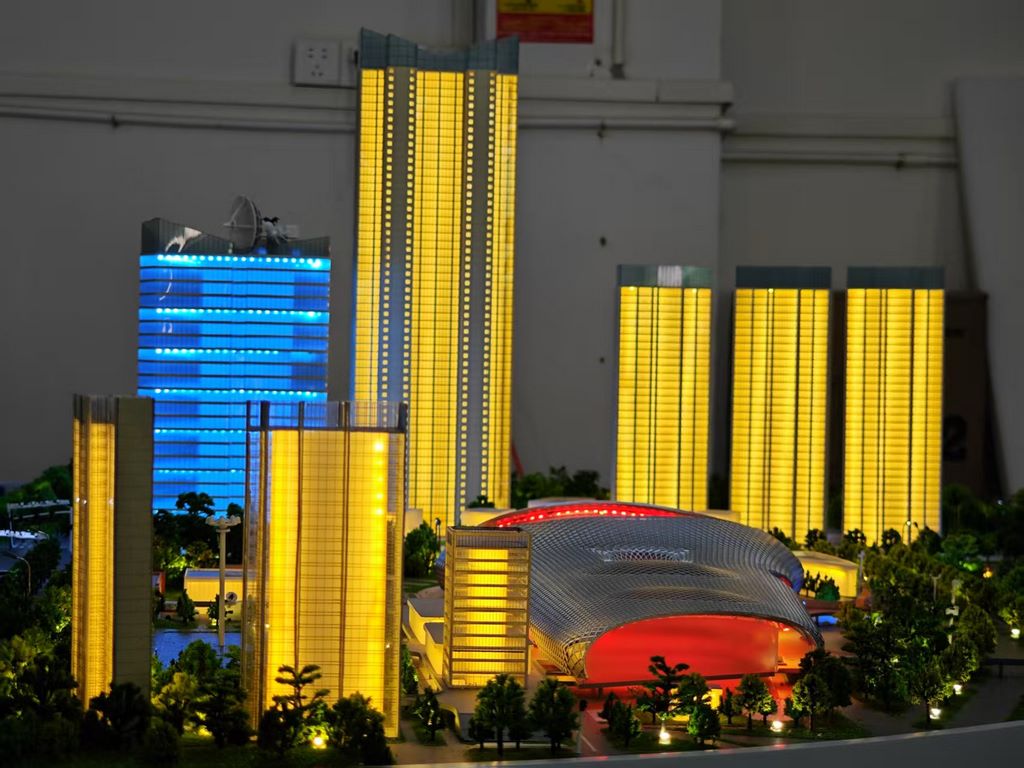
Let us break down what makes a model “modern”.
Minimalist Base
No textured sand.
Use smooth matte grey or white acrylic.
Roads are thin white lines, not painted asphalt.
Simplified Landscaping
Trees are abstract cylinders or clear acrylic rods.
No individual leaves.
Lawns are solid green panels, not flocking.
Clean Building Forms
Facades are smooth acrylic or white painted wood.
No fake brick textures.
Windows are clear or frosted.
Accent Lighting
LED strips hidden under the base.
Buildings glow from within.
No colored lights – only warm or cool white.
A Modern Architectural Scale Model feels like an art piece.
That is exactly what you want in a high‑end sales center.
Materials Used for Modern Models
Professional makers use refined materials.
White acrylic – For building walls and roofs.
Clear acrylic – For glass curtain walls.
Matte MDF – For the base board.
Frosted acrylic rods – For abstract trees.
Cool white LEDs – For interior and landscape lighting.
Laser‑cut paper – For fine details like balcony railings.
Each material is chosen for its clean finish.
The final Modern Architectural Scale Model looks like a gallery sculpture.
The Creation Process: Step by Step
How is a modern sales center model made?
Here is the typical workflow.
Step 1: Design Review and Scale Selection
You provide CAD or BIM files.
The maker studies the building’s geometry.
Scale is chosen (common: 1:50, 1:100, or 1:200).
For a sales center, 1:100 is popular – big enough for detail, small enough for a table.
Step 2: Base Fabrication
A matte grey MDF board is cut.
Road lines are laser‑engraved or painted.
No sand, no texture.
Step 3: Building Core and Facade
The building core is cut from white acrylic.
Each floor slab is stacked.
Facade panels are laser‑cut and glued.
Windows are left clear or frosted.
Step 4: Abstract Landscaping
Instead of realistic trees, clear acrylic rods are inserted.
Lawns are solid green acrylic sheets.
Water features are smooth blue resin without waves.
Step 5: Lighting Installation
LED strips are hidden under the base edge.
Buildings may have internal LEDs.
All wiring is invisible.
Step 6: Final Assembly and Quality Check
The model is dusted.
A clear acrylic cover is added.
The piece is crated for shipping.
A custom Modern Architectural Scale Model typically takes 4 to 6 weeks.
Why Sales Centers Love Modern Models
Sales centers are about emotion and brand.
A modern model builds trust.
Buyers see clean, confident design.
They associate that with your project’s quality.
Also, modern models photograph beautifully.
Your marketing team can use them for social media, brochures, and websites.
A Modern Architectural Scale Model never looks dated.
Five years later, it still feels fresh.
Cost Factors for Modern Architectural Scale Models
Pricing depends on several factors.
Size – 1m x 1m model costs less than 2m x 2m.
Number of buildings – One tower vs. a campus of three buildings.
Detail level – Abstract vs. semi‑realistic (some clients want a few real trees).
Lighting complexity – Simple base lighting vs. floor‑by‑floor LEDs.
Shipping and case – Acrylic cover adds 1,000.
Typical range: 20,000 for a large mixed‑use development with multiple towers.
Modern models are often cheaper than traditional ones because they use fewer materials and less labor on landscaping.
How to Choose a Model Maker for Modern Style
Not every maker understands minimalism.
Look for these qualities.
Portfolio of modern work – Clean white models, not colorful villages.
Close‑up photos – Check the edge quality of acrylic cuts.
Lighting samples – Ask to see warm white vs. cool white.
References from luxury developers – Call two.
Ask for a sample of an abstract tree.
If they give you a detailed painted tree, they are not a modern specialist.
Case Study: Modern Model Doubles Traffic
A developer in Singapore launched a luxury condo.
The target market was young professionals.
They built a Modern Architectural Scale Model for their sales center.
White towers on a grey base.
Clear acrylic “trees”.
Soft warm lighting.
The model became an Instagram hotspot.
Visitors posted photos.
Sales center traffic doubled.
The model cost $12,000.
The project sold out in three months.
That is modern marketing.
Maintenance Tips for Modern Models
Modern models are low‑maintenance but still need care.
Dust weekly with compressed air – Never wet cloths.
Clean the acrylic cover with microfiber – Use glass cleaner on the cover only.
Avoid fingerprints on white surfaces – If touched, clean gently with a dry brush.
Check LEDs annually – Replace burnt bulbs.
With care, your Modern Architectural Scale Model will stay gallery‑fresh for 7+ years.
Common Mistakes to Avoid
Do not add too many details.
A modern model loses its power when cluttered.
Do not use colored lights.
Blue, red, or green lights look tacky in a luxury sales center.
Do not skip the dust cover.
White acrylic shows every speck.
Do not choose a scale that is too small.
At 1:500, modern models look like boring blocks.
Related Architectural Model Types
While this guide focuses on modern sales center models, you may need other styles for different projects.
A High Rise Building Architectural Sand Model is ideal for a single skyscraper. It emphasizes verticality and facade detail – often with realistic textures, not abstract minimalism.
For a sales center that needs to show a large community, a Real Estate Display Architectural Sand Table Model works best. It includes roads, parks, and many buildings, usually in a traditional style.
A Commercial Building Architectural Sand Model focuses on office parks, shopping centers, and hotels. These can be modern or traditional, depending on the brand.
If your project is a luxury villa development, a Villa Architectural Scale Model is the right choice. Villas are often shown at larger scales (1:50) with detailed landscaping – the opposite of modern minimalism.
Finally, for a single office tower, an Office Building Sand Table Model (with realistic facade and context) is cost‑effective and easy to understand.
Each style serves a different buyer. Modern models appeal to contemporary tastes, while traditional models work for family‑oriented communities.
Future Trends in Modern Sales Center Models
Trends are evolving.
Glass and metal finishes – Real metallic paint for a premium feel.
Interactive lighting – Touch a building to see unit availability.
Augmented reality – Scan the model to see interior renderings.
Sustainable materials – Recycled acrylic and LED efficiency.
But the core remains.
Buyers want clean, beautiful, physical representations of their future home.
Conclusion
A Modern Architectural Scale Model is the perfect fit for today’s luxury sales centers.
It is clean, elegant, and photogenic.
From the abstract landscaping to the hidden lighting, every detail matters.
Choose the right maker.
Invest in quality materials.
Display it under a clear cover with soft spotlights.
If you are launching a contemporary project, start the model process early.
Contact two or three model makers who specialize in modern work.
Request quotes and sample pieces.
Your buyers will thank you.
And your sales numbers will show it.
And remember – whether you need a High Rise Building Architectural Sand Model for a downtown tower, a Real Estate Display Architectural Sand Table Model for a large community, a Commercial Building Architectural Sand Model for a shopping center, a Villa Architectural Scale Model for luxury homes, or an Office Building Sand Table Model for a corporate building, the same principles of good design apply. Start with a modern model, then expand your collection.


