Outdoor Exhibition Architectural Sand Model
Introduction
Most sand table models live indoors.
Lobbies, sales centers, museums – safe from the elements.
But what if you need to exhibit outdoors?
A public plaza, a theme park, a botanical garden.
Rain, sun, wind, and dust will destroy a standard model.
You need a model built for the outdoors.
That is an Outdoor Exhibition Architectural Sand Model.
This guide explains how outdoor models are different.
What materials withstand the elements.
And how to commission a durable, weather‑proof display.
Let us begin.
What Is an Outdoor Exhibition Architectural Sand Model?
It is a physical miniature designed to survive sun, rain, wind, and temperature changes.
An Outdoor Exhibition Architectural Sand Model uses:
UV‑stabilized acrylics (they will not yellow).
Waterproof adhesives and sealants.
Rust‑proof metals (stainless steel, aluminum).
Fade‑resistant paints and flocking.
Drainage channels to prevent water pooling.
The model is permanently installed on a concrete plinth or a reinforced weather‑proof base.
It is used in public parks, outdoor museums, university campuses, and resort common areas.
Why Outdoor Models Need Special Construction
A model that survives a climate‑controlled lobby will fail outdoors.
An Outdoor Exhibition Architectural Sand Model must resist:
UV radiation – Sunlight fades colors and yellows acrylic.
Rain and humidity – Water seeps into joints, loosening glue.
Temperature swings – Materials expand and contract, causing cracks.
Wind and dust – Abrasion erodes paint and flocking.
Every material and adhesive must be rated for outdoor use.
Key Features of an Outdoor Exhibition Model
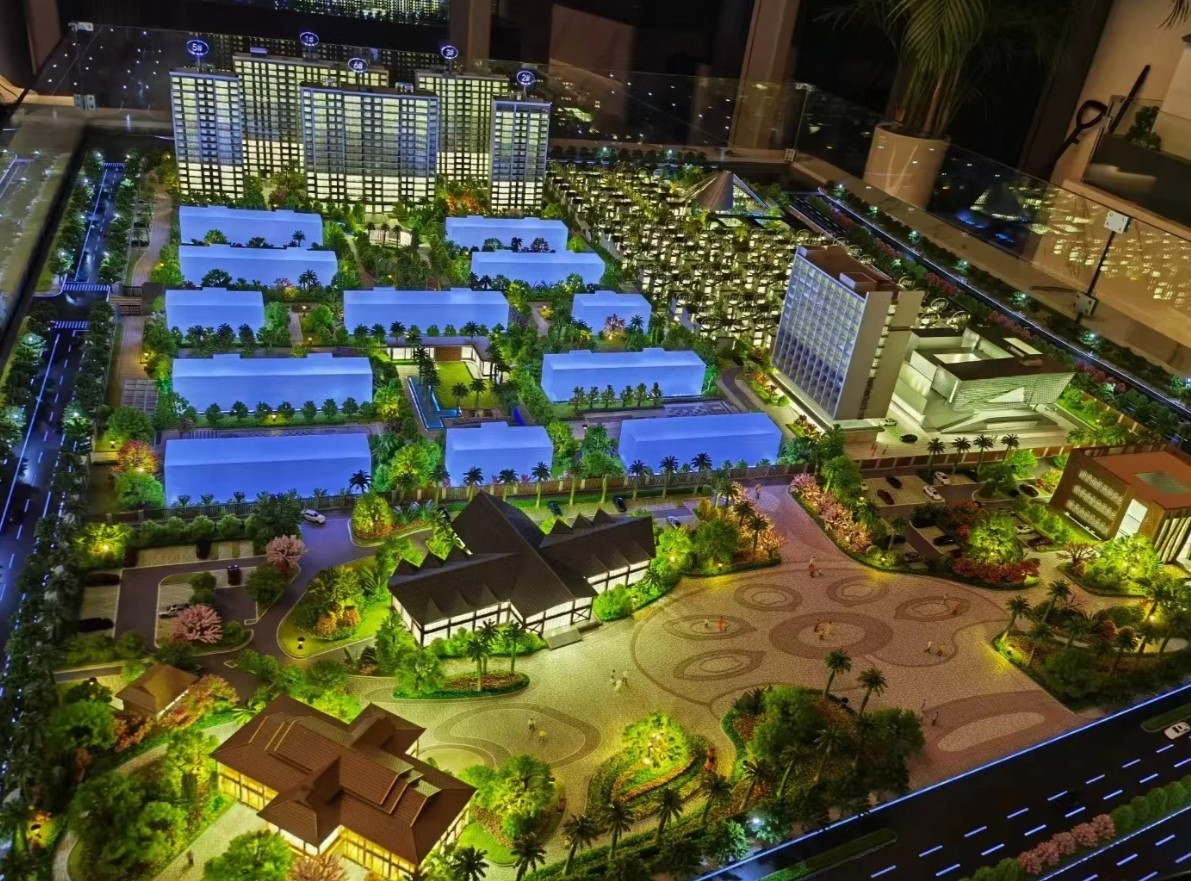
Let us break down what makes a model suitable for outdoor display.
UV‑Stabilized Acrylic
Standard acrylic yellows in sunlight.
Outdoor models use cast acrylic with UV inhibitors.
Clear for water features, but never direct sunlight on thin sheets.
Waterproof Construction
Marine‑grade epoxy for water features.
Sealed joints (silicone or polyurethane).
No exposed MDF – all wood must be sealed or replaced with PVC.
Fade‑Resistant Colors
Automotive‑grade paints or UV‑stable vinyl.
Flocking treated with UV inhibitors.
Rust‑Proof Hardware
Stainless steel screws and brackets.
Aluminum or galvanized steel for structural supports.
Drainage and Airflow
The base should have weep holes to drain water.
Elevated on a plinth to allow air circulation underneath.
Secure Mounting
Bolted to a concrete foundation.
Vandal‑resistant covers for access panels.
The Production Process for an Outdoor Exhibition Model
Step 1 – Site and Climate Assessment
You provide the installation location (latitude, sun exposure, rainfall).
The manufacturer recommends materials and sealing methods.
Step 2 – Digital Modeling and Sampling
A digital 3D model is created.
Before full production, order an Architectural Sand Model Sample Custom with outdoor‑rated materials.
Expose the sample to sun and water to verify performance.
Step 3 – Outdoor‑Rated Fabrication
Laser cutting – UV‑stabilized acrylic and PVC.
3D printing – Weather‑resistant resins.
Sealed assembly – Waterproof adhesives.
Step 4 – Painting and Finishing
Automotive‑grade base coats and clear coats.
UV‑stable flocking applied with extra adhesive.
Step 5 – Base and Mounting Integration
Reinforced aluminum or sealed concrete base.
Stainless steel bolts for anchoring.
Step 6 – Quality Control and Outdoor Testing
Model subjected to simulated rain and UV exposure.
Seams checked for water infiltration.
Step 7 – Packaging and Shipping
Heavy‑duty wooden crate with moisture barrier.
On‑site assembly by factory technicians.
Five Complementary Services for Outdoor Projects
1. Real Estate Developer Sand Table Model – Outdoor Sales Centers
A Real Estate Developer Sand Table Model can be adapted for outdoor sales plazas.
Waterproofing and UV protection allow year‑round display at resort communities.
2. Custom Indoor Display Sand Table Model – Not for Outdoors
A Custom Indoor Display Sand Table Model uses interior‑grade materials.
Do not use it outside.
For outdoor, specify outdoor construction explicitly.
3. Architectural Sand Model Sample Custom – Test Weather Resistance
Before committing to a full outdoor model, order an Architectural Sand Model Sample Custommade with outdoor materials.
Leave it outside for 30 days.
Inspect for fading, cracking, or water damage.
4. Large Project Sand Table Model OEM – Multiple Outdoor Installations
For a theme park or resort with multiple outdoor locations, a Large Project Sand Table Model OEMservice produces identical weather‑proof models for each site.
Volume discounts apply.
5. Custom Museum Exhibition Sand Table Model – Covered Outdoor Exhibits
A Custom Museum Exhibition Sand Table Model designed for indoor use can be placed under a covered outdoor pavilion.
If fully exposed to sun and rain, request the outdoor upgrade.
Materials for Outdoor Sand Table Models
| Material | Standard Model | Outdoor Model |
|---|---|---|
| Acrylic | Extruded (yellows) | Cast acrylic with UV stabilizers |
| Adhesives | Cyanoacrylate (cracks) | Marine epoxy, silicone |
| Paint | Acrylic (fades) | Automotive urethane |
| Wood | MDF (swells) | Sealed hardwood or PVC |
| Flocking | Standard (fades) | UV‑treated flocking |
| Metal | Steel (rusts) | Stainless steel or aluminum |
Case Study: Outdoor Model Survives Five Years in Coastal Park
A coastal resort installed an Outdoor Exhibition Architectural Sand Model of their master plan in a public plaza.
The model was 1:500 scale, 3m x 2m, showing villas, golf course, and marina.
UV‑stabilized acrylic, stainless steel hardware, and marine‑grade epoxy kept it intact.
After five years of direct sun, salt spray, and rain, the model still looked near‑new.
The resort credits the model with increasing property tours by 40%.
Cost Factors for Outdoor Exhibition Models
Size – Larger models cost more.
Weatherproofing complexity – Basic UV protection vs. full waterproofing.
Materials – Outdoor‑rated materials cost 30–50% more.
Installation – Concrete base and bolted mounting.
Shipping – Heavy crates and on‑site assembly.
Typical range: 120,000 for a large, fully weather‑proofed installation.
How to Choose a Manufacturer for Outdoor Projects
Use this checklist.
Outdoor model experience – Request photos of previous outdoor installations.
Material certifications – UV‑stabilized acrylic, marine adhesives.
Testing process – Do they simulate rain and sun exposure?
Warranty – At least 3 years for outdoor models (fading, cracking).
References – Call past outdoor clients (parks, resorts, municipalities).
Common Mistakes to Avoid
Do not use indoor materials outdoors.
They will fail within months.
Do not skip sample testing.
Outdoor conditions vary – test a sample at your specific location.
Do not forget drainage.
Water pooling on flat surfaces leads to leaks.
Do not use MDF anywhere.
It swells and rots.
Do not ignore maintenance.
Outdoor models need annual cleaning and sealant checks.
Future Trends in Outdoor Architectural Sand Models
Self‑cleaning coatings – Hydrophobic surfaces that repel dirt.
Solar‑powered LEDs – Night illumination without wiring.
Modular replacement – Swap out weathered sections.
Recycled weather‑proof materials – Sustainable composites.
Conclusion
An Outdoor Exhibition Architectural Sand Model brings your vision to public spaces, parks, and resorts.
It requires specialised materials and construction.
UV‑stabilized acrylic, waterproof adhesives, and fade‑resistant paints are non‑negotiable.
Start with an Architectural Sand Model Sample Custom made from outdoor materials.
Test it in your actual environment.
For sales centers in resort communities, adapt a Real Estate Developer Sand Table Model for outdoor use.
For indoor lobbies, use a Custom Indoor Display Sand Table Model – but never place it outside.
For multiple park installations, use Large Project Sand Table Model OEM for cost‑effective production.
And for covered outdoor exhibits, a Custom Museum Exhibition Sand Table Model can work with weatherproof upgrades.
Contact a manufacturer with outdoor experience.
Send your site conditions.
Get a durable outdoor quote.
Ready to build an outdoor exhibition architectural sand model? Request a quote with your site photos and climate data. Get a response within 48 hours.


