Manufacturer of maritime logistics sand table models
Maritime Logistics Sand Table Model Production Case
Project Background
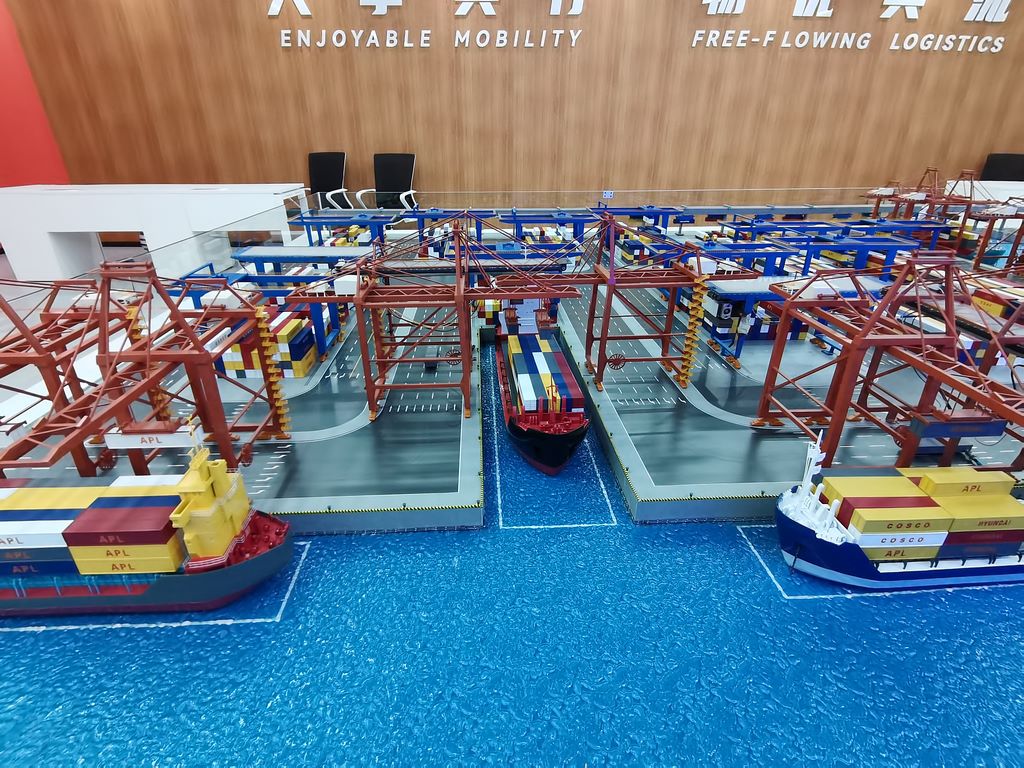
An international shipping group commissioned our team to produc maritime logistics sand table model to showcase its modern logistics operations. The client provided complete port layout plans, ship specifications, and loading equipment photos, requiring the model to accurately replicate container terminals, gantry cranes, quay cranes, cargo ships, and supporting logistics facilities with over 90% restoration accuracy. The model would be used for strategic presentations at the company’s headquarters.
I. Production Process and Workflow
Terrain Shaping and Water Effects
High-density foam boards were CNC-carved to recreate the port’s coastline, berth depths, and breakwater structures.
The water surface was made using layered acrylic sheets—deep blue gradient paint for the ocean base, topped with specialty resin and handcrafted wave textures.
Port Facility Construction
Dock Surface: Laser-cut 3mm PVC panels were used, sandblasted for a concrete-like texture, with container yard markings precisely engraved.
Gantry and Quay Cranes: The main structure was welded from stainless steel tubes, with micro-bearings enabling smooth pulley movement. Steel cables were simulated using 0.2mm fishing lines.
Containers: ABS panels were assembled into container shapes, with etched company logos and serial numbers. Weight blocks were added inside to simulate loaded cargo.
Ships and Dynamic Systems
Cargo Ship Model: The hull was fiberglass-cast, while the superstructure was 3D-printed in resin. Deck container placements matched the client’s stowage plan.
Loading Simulation: Micro-motors powered the gantry crane trolleys, programmed to replicate automatic container pickup, transfer, and stacking.
Support Vessels: Tugboats used magnetic levitation bases for guided movement, while pilot boats featured miniature water pumps to simulate wake effects.
II. Material Selection
Mechanical Equipment: Quay crane turntables were CNC-machined from brass, with hydraulic rods made of chrome-plated stainless steel and silicone dust covers.
Environmental Details:
Breakwaters were covered with scaled-down real gravel and moss effects using electrostatic flocking.
Floating debris in the water was simulated with transparent resin droplets, mimicking plastic waste and oil slicks.
The port lighting system used fiber optics, with street lamps spaced accurately and individually controllable.


