3D Printing Architectural Sand Table Model
Introduction
Traditional sand table model making takes weeks.
Hand‑cutting, gluing, and painting require skilled labor and patience.
But what if you could skip much of that manual work?
3D printing changes the equation.
A 3D Printing Architectural Sand Table Model combines digital design with additive manufacturing.
It delivers complex shapes, tight tolerances, and fast revisions.
This guide explains how 3D printing is transforming the industry.
What it can and cannot replace.
And how to integrate it into your next project.
Let us begin.
What Is a 3D Printing Architectural Sand Table Model?
It is a physical miniature where most or all components are produced using additive manufacturing.
A 3D Printing Architectural Sand Table Model typically uses:
SLA (stereolithography) or DLP resin printers for fine details.
FDM (fused deposition modeling) for larger, less detailed parts.
Binder jetting for sand‑like texture and full‑color models.
The digital file is your CAD or BIM data.
The printer builds the model layer by layer directly from that file.
No laser cutting, no CNC milling, no hand‑carving of complex shapes.
Why 3D Printing Is Gaining Popularity
Unmatched Geometric Freedom
Curved facades, twisted towers, organic terrain – 3D printing handles shapes that are difficult or impossible to cut from flat sheets.
Rapid Iteration
Design changes are made in the digital file, not on the workbench.
A revised model can be printed overnight.
Consistent Reproduction
Once the digital file is perfected, every print is identical.
This is essential for Architectural Sand Model Bulk Production where 10, 50, or 100 identical units are needed.
Integration with Other Materials
Printed parts can be combined with laser‑cut acrylic, wooden frames, or metal bases.
The model is not limited to one material.
The 3D Printing Production Process
Step 1 – Digital Model Preparation
You provide CAD, BIM, or 3D file (STL, OBJ, 3MF).
The file is checked for watertightness and printability.
Step 2 – Material Selection
Standard resin – For fine details, smooth surfaces.
Tough resin – For parts that will be handled frequently.
Sand/binder – For full‑color terrain or textured models.
ABS filament – For large, durable components (complementing an ABS Material Architectural Sand Table Model approach).
Step 3 – Printing and Post‑Processing
Parts are printed, washed, and UV‑cured (for resin).
Supports are removed.
Parts are sanded or primed as needed.
Step 4 – Assembly and Finishing
Printed components are glued together.
Painting and landscaping added by hand.
The model is mounted on a base – which could be a Wooden Frame Architectural Sand Table Model for a warm, natural presentation.
Step 5 – Quality Control
Dimensional accuracy verified.
Printed parts matched to the digital source.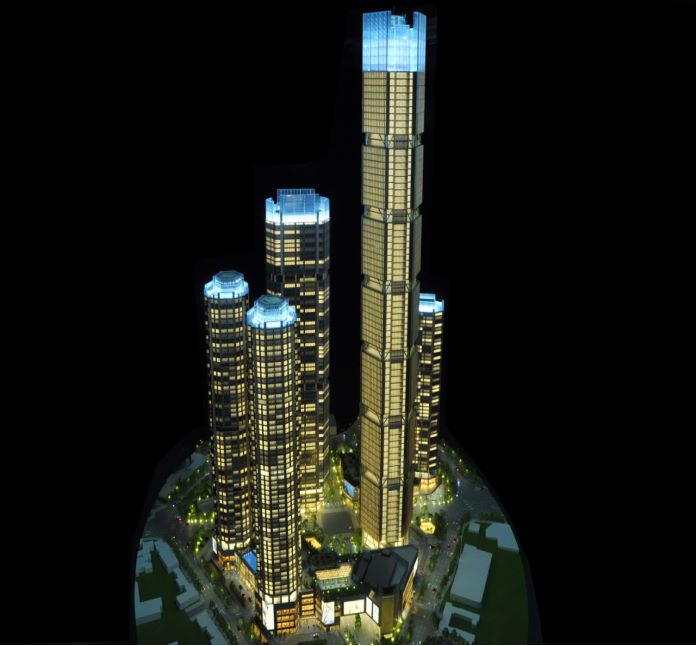
Five Applications of 3D Printed Sand Table Models
1. Wooden Frame Architectural Sand Table Model – Natural Display Base
A Wooden Frame Architectural Sand Table Model provides an elegant, eco‑friendly foundation for 3D printed components.
The contrast of high‑tech printed buildings with a warm wooden frame is striking.
Ideal for luxury sales centers and museum exhibits.
2. Metal Structure Urban Planning Sand Model – Heavy‑Duty Support
For large or permanent installations, a Metal Structure Urban Planning Sand Model base offers unmatched rigidity.
Printed components are lightweight but require a perfectly flat, stable foundation.
Metal frames also provide integrated cable management for printed models with LED lighting.
3. Architectural Sand Model Bulk Production – Consistent Copies
3D printing excels at Architectural Sand Model Bulk Production.
Once the master file is ready, printing 50 identical buildings is as easy as printing one.
No additional tooling or setup costs.
4. ABS Material Architectural Sand Table Model – Durable Components
For parts that will be handled frequently (e.g., removable buildings in an interactive display), ABS Material Architectural Sand Table Model components can be 3D printed using FDM.
ABS is impact‑resistant and does not warp in humidity.
5. Resin Craft Urban Planning Scale Model – Ultra‑Fine Detail
When every window mullion and roof tile must be perfect, a Resin Craft Urban Planning Scale Model produced via SLA or DLP printing delivers micron‑level resolution.
Resin captures details that laser‑cut MDF or ABS cannot.
Case Study: 3D Printed Model Saves 60% Production Time
A landscape architecture firm needed a detailed topographic model for a resort master plan.
Traditional foam carving would have taken four weeks.
They used a 3D Printing Architectural Sand Table Model approach.
The terrain was printed in sections using a large‑format FDM printer.
Buildings were printed in resin.
Total production time: 10 days.
The client received the model two weeks earlier than expected.
Cost Factors for 3D Printed Sand Table Models
Print volume – Larger models require more print time or sectioning.
Resolution – Fine details (0.05mm layer height) cost more than coarse (0.2mm).
Material – Standard resin is affordable; engineering resins and sand printing cost more.
Quantity – Single model vs. bulk production (economies of scale).
Post‑processing – Hand painting and assembly add cost.
Typical range: 25,000 for a large, multi‑material printed model with finishing.
How to Choose a 3D Printing Partner
Use this checklist.
Printer capabilities – SLA, DLP, FDM, or binder jetting.
Build volume – Can they print components up to 50cm or more?
Material options – Resin, ABS, PLA, nylon, sand.
Post‑processing – Washing, curing, sanding, painting.
References – Request examples of printed architectural models.
Common Mistakes to Avoid
Do not print without checking the digital file for errors.
Non‑manifold geometry, inverted normals, or zero‑thickness walls will fail.
Do not use standard resin for outdoor models.
It degrades in UV. Use engineering or outdoor‑rated materials.
Do not skip post‑processing.
Uncured resin remains tacky and brittle.
Do not assume printing is always faster than traditional methods.
For simple, repetitive shapes (massing blocks), laser cutting may be quicker.
Future Trends in 3D Printed Sand Table Models
Multi‑material printing – Rigid and flexible parts in one print.
Full‑color sandstone printing – No painting required.
AI‑assisted file repair – Automated fixes for problematic CAD data.
On‑site printing – Portable printers for last‑minute exhibition models.
Conclusion
A 3D Printing Architectural Sand Table Model offers speed, precision, and design freedom that traditional methods cannot match.
It is ideal for complex geometries, rapid iterations, and bulk production.
For the display base, choose a Wooden Frame Architectural Sand Table Model for natural elegance or a Metal Structure Urban Planning Sand Model for industrial strength.
Produce multiple identical units with Architectural Sand Model Bulk Production.
For durable, impact‑resistant components, use ABS Material Architectural Sand Table Modelprinting.
And for the highest detail, a Resin Craft Urban Planning Scale Model from SLA printing delivers micron‑level resolution.
Contact a 3D printing specialist today.
Send your CAD files.
Get a fast, precise quote.
Ready to produce a 3D printing architectural sand table model? Request a quote with your 3D files and material preferences. Get a response within 48 hours.


