Tiangong Space Station Model Manufacturing Factory
High-Precision Model Construction of the Tiangong Space Station
Core Objective: To replicate the main structure of the Tiangong Space Station at a 1:50 scale, achieving 90% visual fidelity, with a focus on showcasing the industrial aesthetics of the spacecraft and space operation scenarios.
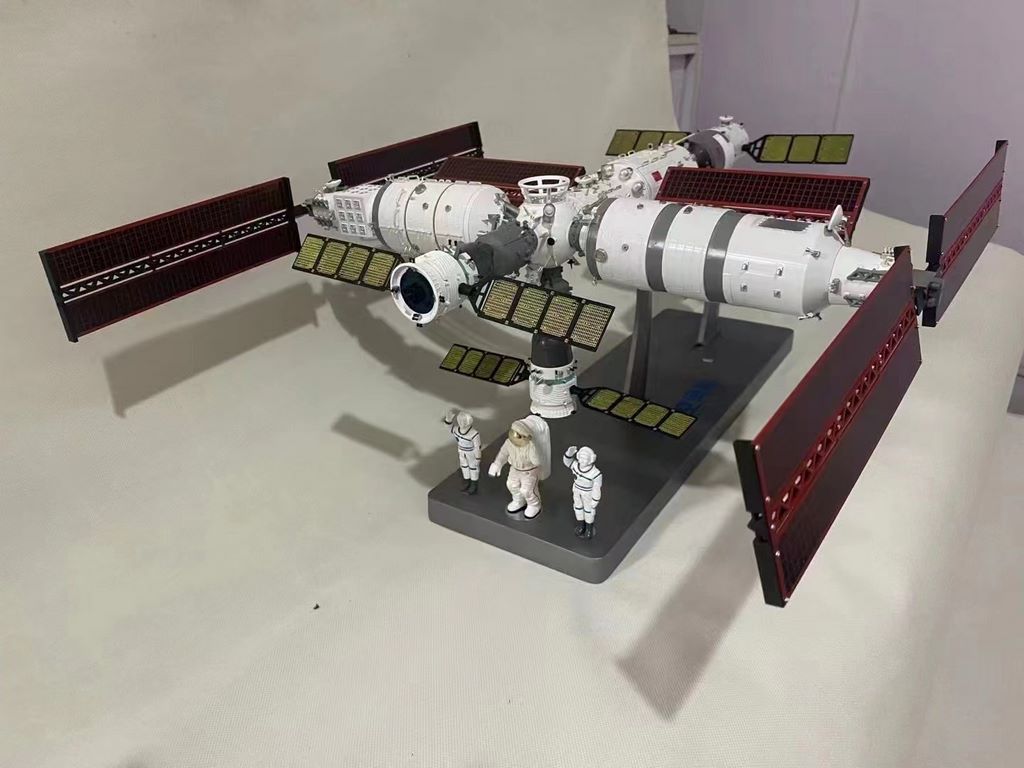
Core Production Process
Phase One: Precision Shaping of the Frame
Cabin Casting: 2mm aviation-grade ABS panels are laser-cut and then formed using a hot-press moulding process. The living module is softened at high temperatures in a custom mould to create an octagonal prism shape with curved edges; the node module is precisely machined using a five-axis CNC machine to replicate the spherical-conical composite structure, with carbon fibre frames embedded at critical load-bearing points.
Seamless Assembly: Cabin segments are pre-embedded with aerospace-grade aluminium mortise-and-tenon structures and assembled using a microscopic positioning instrument. Seams are filled with ultra-fine putty and undergo three rounds of grinding, resulting in a final gap of ≤0.05mm (equivalent to a 5mm tolerance in real cabin segments).
Phase Two: Creation of Signature Components
Solar Wing Panels:
0.8mm semi-transparent red acrylic sheets are softened in a temperature-controlled chamber, moulded over curved moulds to simulate natural curvature under microgravity in space.
The panel surfaces are precision-laser-etched with 0.1mm-deep honeycomb patterns, filled with amber-coloured epoxy resin, and cured to form raised three-dimensional photovoltaic lattices.
Robotic Arm System:
Titanium alloy rods are machined into seven movable arm segments, with miniature bearings embedded in the joints. The end grippers are crafted from etched steel plates to replicate the serrated texture of claws.
Phase Three: Refining the Finishing Touches
Astronaut sculpting: An 11cm figurine is cast from tin-based alloy, with liquid cooling tubes and reflective strips on the helmet visor hand-carved under a 40x magnifying glass.
Cabin instrumentation: The thruster nozzles are precision-machined from brass tubes, and the portholes are fitted with double-coated sapphire glass.
Colour and weathering key processes
Cabin coating:
Seven layers of specially formulated space white paint alternately sprayed (matte primer + semi-gloss topcoat), cured in a 65°C oven to completely avoid reflective orange peel texture
Laser-cut steel moulds used for precise spray painting along grey skin seams, with edges as sharp as engineering drawings
Wing panel optical treatment:
Red substrate first coated with matte black primer to enhance light absorption, then covered with transparent red resin, and finally coated with anti-glare nano-coating
Yellow battery cells embedded with LED lights, transmitting epoxy resin lattice to produce star-like light effects
Authentic aging:
Use a 000-grade face brush dipped in gray-green transparent paint to draw heat control film wrinkles and shadows in the heat dissipation area.
Engrave micro-indentations around the thrusters and fill them with aluminium powder to simulate space particle impacts.


