High precision ship model production case: Process analysis of ocean container ship model
1、 Project Background
This ship model production project is a high-precision display model of ocean going container ships customized for international shipping companies, mainly used for enterprise exhibition halls, international maritime exhibitions, and customer business negotiations. This model is based on a real operating container ship and requires precise reproduction of the hull line, superstructure, deck equipment, container layout, and navigation lighting system, while ensuring structural stability, movable details, and visual realism, meeting the dual expectations of overseas customers for industrial model professionalism and artistic sense. The production team adopts a composite process of "digital modeling+manual refinement+functional integration", and through the organic combination of lightweight wood skeleton, fiberglass skin, ABS engineering plastic, and 3D printed parts, ultimately achieves a perfect presentation of the streamlined appearance of the ship, movable deck equipment, and navigation lighting system.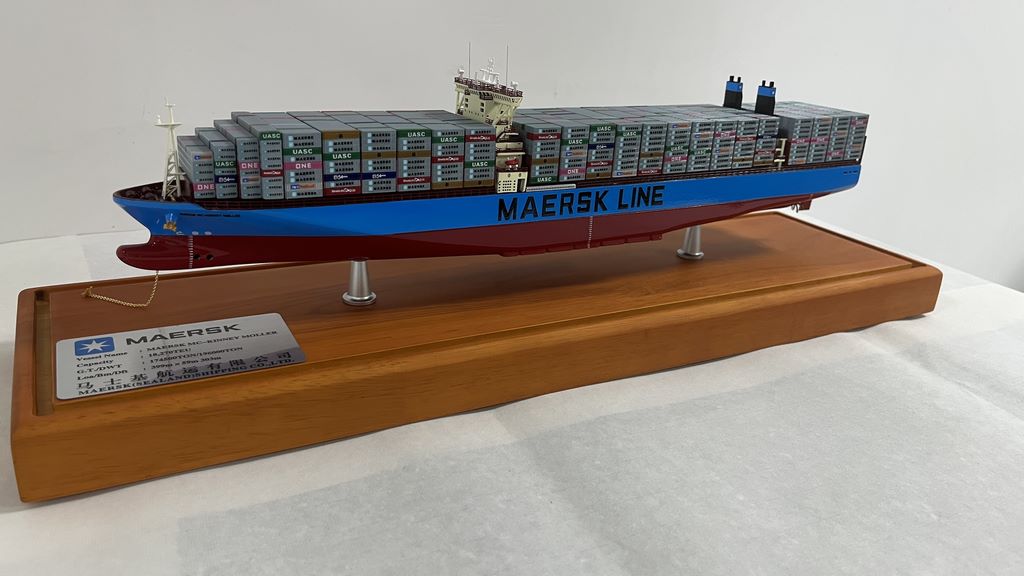
2、 The entire process of core production technology
1. Data conversion and digital disassembly
Prototype data collection: Based on the provided ship line drawing, general layout drawing, and 3D CAD model, scale (1:100) to optimize the continuity of the hull surface, the hierarchical relationship of the superstructure, and the layout of deck equipment.
Modular disassembly: The ship structure is divided into seven modules: "bottom+side+deck+superstructure+deck equipment+container+base", and digital sub models are established to ensure that each component can be independently assembled and maintained in the later stage.
2. Hull skeleton production and skin forming
Light wood skeleton carving: Select lightweight and high-strength Balsa light wood, carve the internal skeleton of the ship in sections according to the digital line diagram, and reinforce it with wood glue splicing. Key load-bearing parts are embedded with carbon fiber rods to enhance structural stability.
Fiberglass skin pouring: Based on a lightweight wood skeleton, fiberglass is vacuum poured to form the outer skin, with uniform thickness control to cover the entire hull shape, forming a smooth and seamless outer surface. After demolding, the fiberglass skin is finely polished, gradually transitioning from coarse to fine grinding to eliminate texture defects and lay the foundation for subsequent coating.
3. Fine craftsmanship of superstructure and deck equipment
ABS engineering plastic molding: ABS board carving and splicing technology is used for upper buildings such as the cab, chimney, and living area. The shape is roughly machined using a CNC carving machine, and details such as window openings, ventilation grilles, and railing bases are manually refined; Use ABS strips to simulate stairs and passages between multiple decks, ensuring coordinated structural proportions.
Fine processing of 3D printed parts: Complex deck equipment such as cranes, mooring bollards, anchors, and lifeboats are printed using high-precision photopolymerization 3D printing (resin material). After printing, the surface of the model is cleaned, unsupported, and dried. The layered patterns are polished to a smooth finish with polishing paste, and small components such as crane hooks and steel cables are further restored with etched pieces or metal wires.
4. Surface coating and detail texture enhancement
Color separation coating process: The exterior surface of the ship is painted in different areas according to the real ship coating scheme, with anti fouling paint (simulated red) applied to the bottom of the ship, matte white paint applied above the waterline, and anti slip texture paint applied to the deck area; The windows of the upper building cab are sprayed with transparent paint to simulate glass, and the chimney logo is restored to the corporate logo using screen printing technology.
Detail texture enhancement: The railing is made of 0.3mm metal wire, manually bent and welded for fixation; Etching sheets are used to create ventilation grilles and equipment nameplates, which are precisely adhered using instant glue; Dry cleaning and aging techniques are used to treat deck equipment, simulating the usage traces of real ships, such as rust on cranes and wear on mooring bollards.
5. Functional system integration and final assembly
Navigation lighting system: Micro LED light beads are pre embedded at the navigation light position on the top of the cab. The deck work lights and ship side lights are connected in series through thin wires and hidden inside the hull, with only the lamp head exposed externally. The light color strictly follows international navigation rules (left red, right green), and can simulate real navigation conditions after power on.
Container layout and fixation: According to the actual container layout plan, a standard box body is made of ABS board, with enterprise identification and number printed on the surface. It is fixed to the deck by magnetic suction or buckle method to ensure neat layout and flexible adjustment.
Final assembly and debugging: Assemble the ship's hull, superstructure, deck equipment, containers and other modules in sequence, check the accuracy of the connection between each component, adjust the movable angle of the crane arm and the rotation function of the anchor, test the stability of the lighting system, and finally install it on a wooden base. The surface of the base is covered with simulated grass or nautical chart textures to enhance the display scene.
3、 Process Summary
This ship model achieves high-precision restoration from hull line shape to deck equipment through the full process technology of "digital modeling → light wood skeleton+fiberglass skin forming → ABS+3D printed part detail restoration → functional system integration". The combination of manual refinement and modern craftsmanship not only ensures the structural strength and mobility of the model, but also enhances the real texture through techniques such as color separation coating and aging treatment, meeting the dual needs of overseas customers for professionalism and artistic sense. It is suitable for business exhibitions, international exhibitions and other scenarios, and has become an important carrier for conveying ship design and shipping culture.


