I. Project Preparation Stage
Materials List:
Lightweight wood/carbon fiber frame (wingspan approx. 30 cm)
Monocrystalline silicon solar panel (6V/100mA)
Micro brushless motor (diameter 20 mm)
3.7V lithium battery (with charge/discharge protection)
Polyester film skin (thickness 0.05 mm)
Model aircraft-specific adhesive, hot glue gun
Digital multimeter, miniature soldering iron set
Tool Preparation:
Laser cutter (or precision hand saw)
Electronic scale (accuracy 0.1g)
Sunlight simulator (optional)
2. Step-by-Step Construction Process
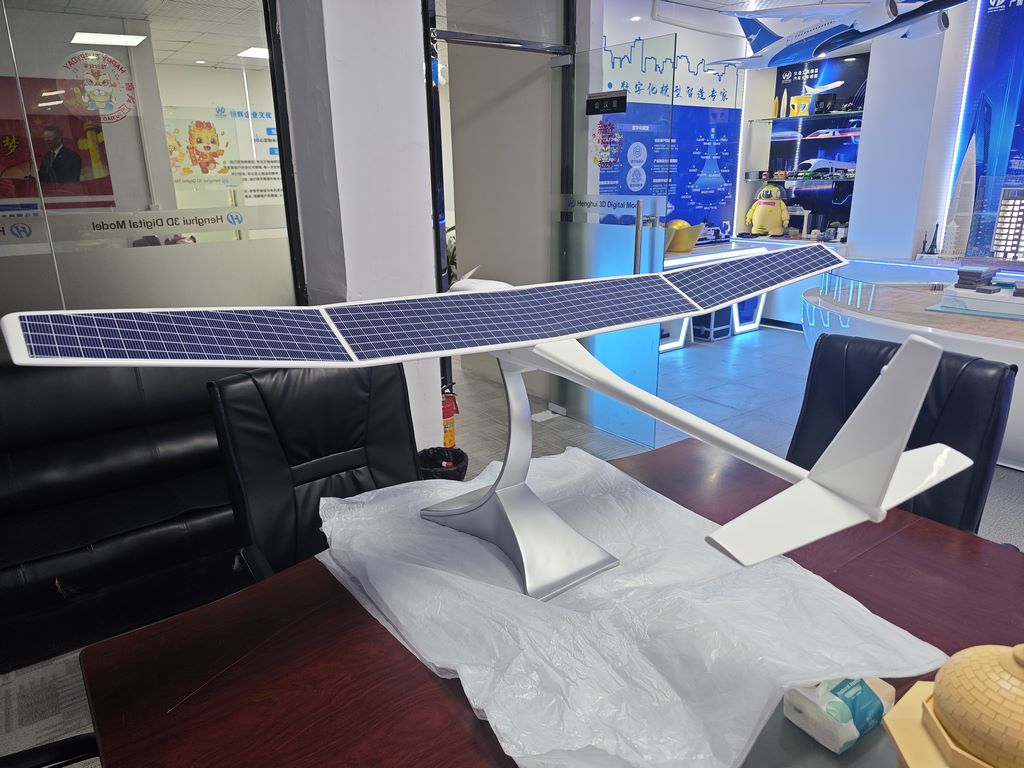
1. Airframe Frame Construction Adopt a “cross-shaped” aerodynamic layout:
Main wings use the NACA2412 airfoil, with ribs cut from lightweight wood using a laser cutter
Tail section made from 1mm carbon fiber tubes to ensure longitudinal stability
Maintain a constant temperature of 25°C during epoxy resin bonding
2. Energy system integration
Solar panels are installed at a 15° angle on the upper surface of the wings
Weld anti-reverse diodes (model 1N5817)
Test the output voltage at an irradiance of 800 W/m² (should be ≥5.2 V)
3. Power System Calibration
Install the motor inside the nose fairing
Control the rotational speed using a PWM speed controller (8000–12000 rpm)
Select a 5×3 propeller, with static balance test offset <0.01g
III. Key Technical Points
Weight Control: Total aircraft mass does not exceed 80g, thrust-to-weight ratio ≥0.8
Sun Tracking: Can be equipped with a light-sensitive sensor to achieve automatic yaw control
Fault Handling: Set low voltage alarm (3.3V automatic shutdown)
IV. Optimization Recommendations
Use matte black paint to reduce surface reflection
Install deflector strips along the edges of the solar panels
Regularly clean the photovoltaic surface with alcohol wipes
Maintain storage environment humidity between 40%–60%


