Highway model production plan
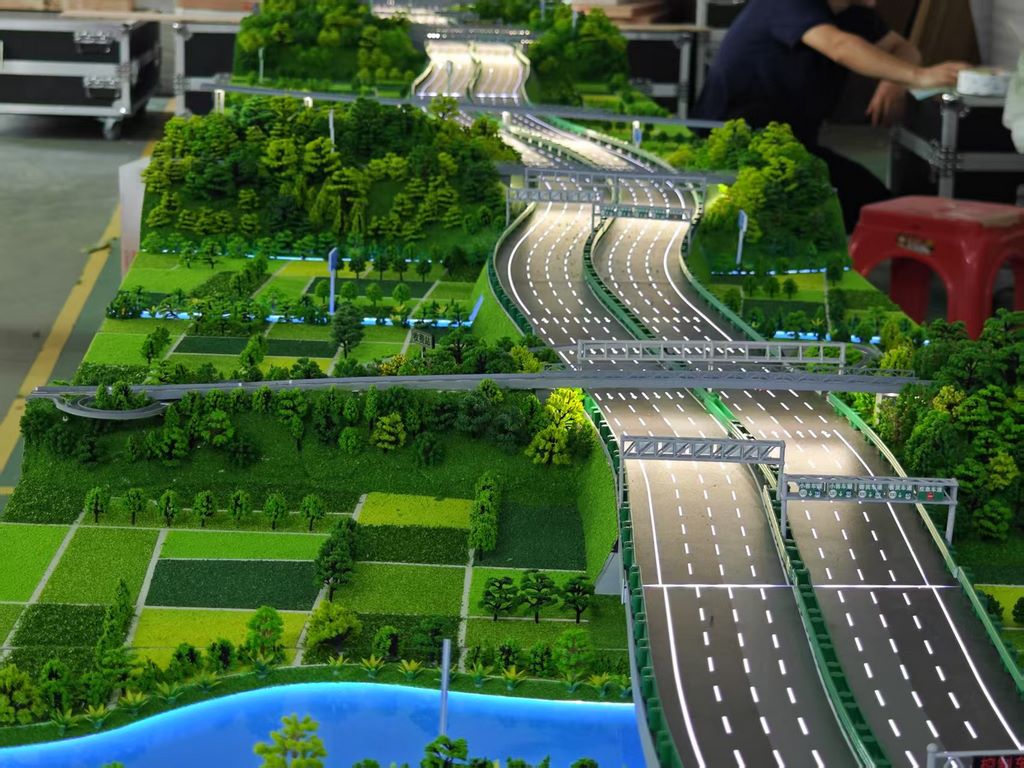
1、 Project Overview
The highway model is used to visually display the spatial layout, structural features, and surrounding environment of highways, and can be applied to engineering design exhibitions, teaching demonstrations, science popularization education, and other scenarios. This plan revolves around three core goals: structural restoration, rich details, and scene coordination. The design is carried out from material selection, production process to detail optimization.
2、 Production process and technical points
(1) Preparation: Planning and Materials
Design Planning
Refer to real highway drawings (such as roadbed width, bridge span, interchange form) to determine the model scale (recommended 1:500-1:1000, balance details and volume).
Draw top and elevation views of the model, annotate key elements such as road direction, bridge location, and distribution of green belts.
Material selection
Main body of the road: black/gray acrylic sheet (simulating asphalt pavement), white acrylic strip (marking), and green PVC sheet (guardrail) are selected.
Bridge structure: metal wire mesh (simulating bridge railings), thin wooden strips/metal sheets (bridge piers, bridge body).
Greening and Environment: Simulated lawn (green velvet), microplastic trees (with green flocking), small plastic buildings (simulating surrounding facilities).
Foundation base plate: wooden/acrylic board (bearing model, reserved splicing interface).
(2) Core module production
1. Road system
Road surface production:
Cut the acrylic board into the shape of a road and paste the markings with white acrylic strips (proportionally reduce the spacing between real markings, such as dashed lines, solid lines, and parting lines).
Paste green PVC boards (guardrails) on the edge of the road to simulate highway barriers.
Stereoscopic cross production:
Refer to the "Multi story Interchange" structure in the picture, use acrylic panels of different heights to build the upper and lower roads, ensuring that the height difference between floors meets the design proportion.
Use thin wooden strips/metal sheets to make bridge piers, support upper roads, and simulate bridge structures.
2. Bridge system
Bridge body and railing:
Build bridge railings using metal wire mesh or thin wooden strips to simulate the grid/member structure of real guardrails.
The bridge body shall be cut with acrylic plate or foam plate, and a gap shall be reserved at the connection with the pier (simulating the expansion joint of the bridge).
Bridge pier fabrication:
Cut thin wooden strips/metal sheets into rectangular/circular bridge piers, and paste the bottom onto the foundation slab to ensure stability.
3. Greening and Environment
Vegetation arrangement:
Lay simulated lawns and green belts on both sides of the road and in the gaps between interchanges.
Arrange microplastic trees proportionally along both sides of the road or the edges of interchanges to restore the natural landscape.
Surrounding facilities:
Simulate toll stations, service areas, monitoring poles, and other facilities: Use small plastic buildings (such as rectangular models) to represent buildings, thin metal poles to represent monitoring poles, and small red flags to simulate traffic signs.
(3) Detail optimization and presentation
Light, Shadow, and Texture
Stick LED light strips (battery powered) at the bottom of roads and bridges to simulate nighttime lighting effects and enhance the realism of the scene.
Using acrylic paint to age acrylic pavement (such as simulating asphalt texture) to enhance visual realism.
Splicing and Display
Reserve splicing interfaces (such as mortise and tenon structures) on the foundation slab to achieve multi module splicing and meet the display needs of "large-scale highway networks".
Install universal wheels at the bottom of the model for easy mobility and display; A transparent acrylic cover is installed at the top to protect the model and facilitate viewing.
3、 Summary of key production points
Proportional control: Strictly scale according to the design ratio to ensure coordinated dimensions of elements such as roads, bridges, and greenery.
Structural stability: Bridge piers and road supports must be firm to avoid model collapse.
Detail restoration: The details of markings, guardrails, vegetation, etc. need to be precise and simulate real highway scenes.


