Case study on the production of low altitude flight economic models: the "miniature world" of airport sand tables
In the exploration of low altitude flight economy, airports serve as the core hub, and their model production is not only a spatial reproduction, but also a concrete expression of industrial ecology. Taking the airport sand table as an example, break down the entire process from design to presentation.
1、 Preliminary Preparation: Drawing Decoding and Material Selection
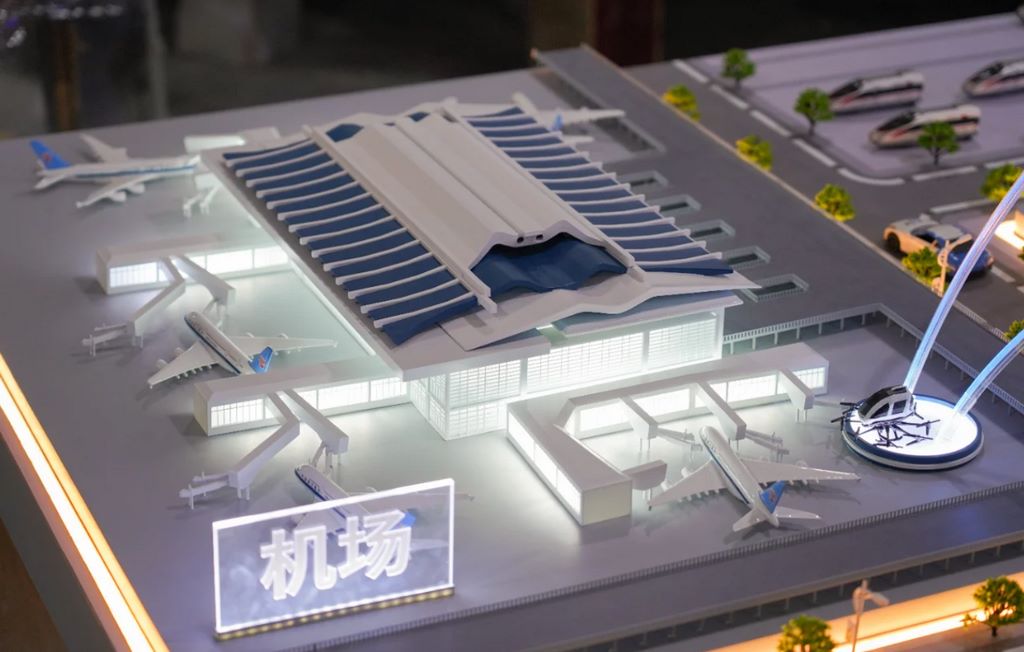
Starting with basic information such as airport building drawings, terminal structure drawings, runway planning drawings, etc., use a scale tool to scale the actual size to 1:500-1:1000 (adjusted according to the display scene) that the model is compatible with. In terms of material selection, the main structure uses high-strength foam boards (light and easy to cut) to build the skeleton, the outer wall of the terminal uses PVC boards (simulating the permeability of the glass curtain wall), and the roof uses acrylic boards (restoring the light and shadow layers of the glass roof); The runway and apron are made of dark gray epoxy resin (wear-resistant and simulated asphalt texture), while the surrounding greenery is a combination of simulated lawn (soft and natural) and resin small trees (realistic in shape).
2、 Main production: "skeleton construction" of architecture and runway
Terminal frame: cut the "L-shaped" main body of the terminal with foam plate, fix it with hot melt adhesive, paste the PVC plate along the outer wall contour, and then use the carving knife to simulate the vertical separation line of the glass curtain wall; The acrylic plate on the roof is cut into corresponding shapes, and after the edges are polished smooth, it is fixed on the foam skeleton with transparent tape to form a "glass top" structure.
Runway and apron: Epoxy resin is poured in different areas, and after solidification, it is polished flat with fine sandpaper; The runway markings are hand drawn with white acrylic paint (strong weather resistance), while the apron is simulated with gray paint to mimic asphalt texture.
3、 Detail filling: the "soul injection" of airplanes, bridges, and light and shadow
Aircraft and Covered Bridge: Aircraft models are purchased from professional model stores (1:100-1:200 scale) and placed according to actual parking positions; The corridor bridge is made of ABS plastic pipe (lightweight and easy to bend) as the skeleton, wrapped with PVC sheet on the outer layer, simulating the curvature and texture of a "telescopic corridor bridge".
Light and shadow system: LED light strips are embedded at the bottom of the model (warm light simulates daytime, cold light simulates nighttime), connected in series with wires to a small power box, and the lighting mode is switched through a remote control to restore the day night light and shadow changes of the airport.
4、 Post production coloring and detail optimization
Architectural coloring: The exterior walls of the terminal building are coated with light gray acrylic paint (evenly covered with PVC sheets), and the acrylic sheets on the roof retain a transparent texture, with only the edges painted with blue paint to simulate the sky; Runway epoxy resin with dark gray pigment (reinforced asphalt texture).
Greening and Decoration: When laying simulated lawns, use scissors to trim the natural contours; Resin trees are arranged according to the principle of "density and staggered" to simulate real green belts; Paste acrylic luminous characters (engraved with the words "airport") at the entrance of the terminal, and simulate LED identification lights after power on.
5、 Restoration verification: 90% "realism"
After production, compare the real airport aerial images with the model: the "L-shaped" structure of the terminal building, the light and shadow on the glass roof, the layout of the runway and apron, and the interactive relationship between the aircraft and the corridor bridge are all highly matched with the real scene; After the light and shadow system is turned on, the changes in light and shadow in day night mode also restore the visual logic of airport operations. In the end, the model achieved a 90% fidelity in spatial structure, material texture, and lighting atmosphere, becoming a "miniature sample" of airport ecology in the low altitude flight economy


