High precision ship scale model making for displaying or collecting customizable ship models
Case study of making a roll on/roll off ship model: presenting the entire process from design to finished product
1、 Design and Prototype Construction: Restoring the 'Soul' of Real Ships
Before production, the design team first conducted a 1:50 scale design of the hull structure, superstructure, deck layout, etc. of the passenger roll on/roll off ship through high-definition photos, drawings, and actual ship data to ensure that the model is consistent with the shape and proportion of the actual ship. Draw a 3D model using CAD software, focusing on restoring details such as the curvature of the ship's hull, the tilt angle of the cab glass, and the spacing between deck railings, to form a digital prototype that can be directly used for 3D printing.
2、 Material selection: A "hardcore" configuration that balances texture and durability
Main structure: The hull shell is made of ABS engineering plastic, which is layered and formed through 3D printing to ensure smooth curvature and resistance to deformation of the hull; The deck and superstructure frame are made of carbon fiber board, which is lightweight and has high strength, and can support the overall structure of the model.
Detail components: The cabin glass is made of acrylic sheet, and after cutting and polishing, the transparency is close to that of real glass; Small components such as lifebuoys and railings are made of PVC soft rubber, which has strong plasticity and can accurately replicate rounded edges; The anti slip pattern on the bottom of the hull is made of rubber material, restoring the texture of the actual ship deck.
Base: high-density foam board is selected as the base, and the surface is covered with white matt paint, which not only firmly bears the load, but also highlights the main body of the model through a simple base.
3、 Craftsmanship: a combination of manual and mechanical "delicate work"
3D printing and cutting: Large components such as ship hulls and superstructures are printed layer by layer using a 3D printer. After printing, the surface is polished with sandpaper from coarse to fine (80 mesh → 240 mesh → 400 mesh) to remove layer patterns and create a delicate touch.
Manual splicing and assembly: Small components such as deck railings and lifebuoys are made by laser cutting and manually welded and fixed in corresponding positions on the hull to ensure uniform spacing and consistent angles; The cab window frame is formed by bending metal sheets, embedded with acrylic glass, and sealed with glue to simulate the sealing structure of a real ship.
Detail depiction: The name and number of the "Strait" ship on the side of the hull are made of metal etching sheets, manually pasted and polished with fine sandpaper to avoid stiffness; The anchor chains and cables on the deck are made of 0.5mm diameter nylon wire, manually wrapped and fixed on anchor piles to restore the actual usage status of the ship.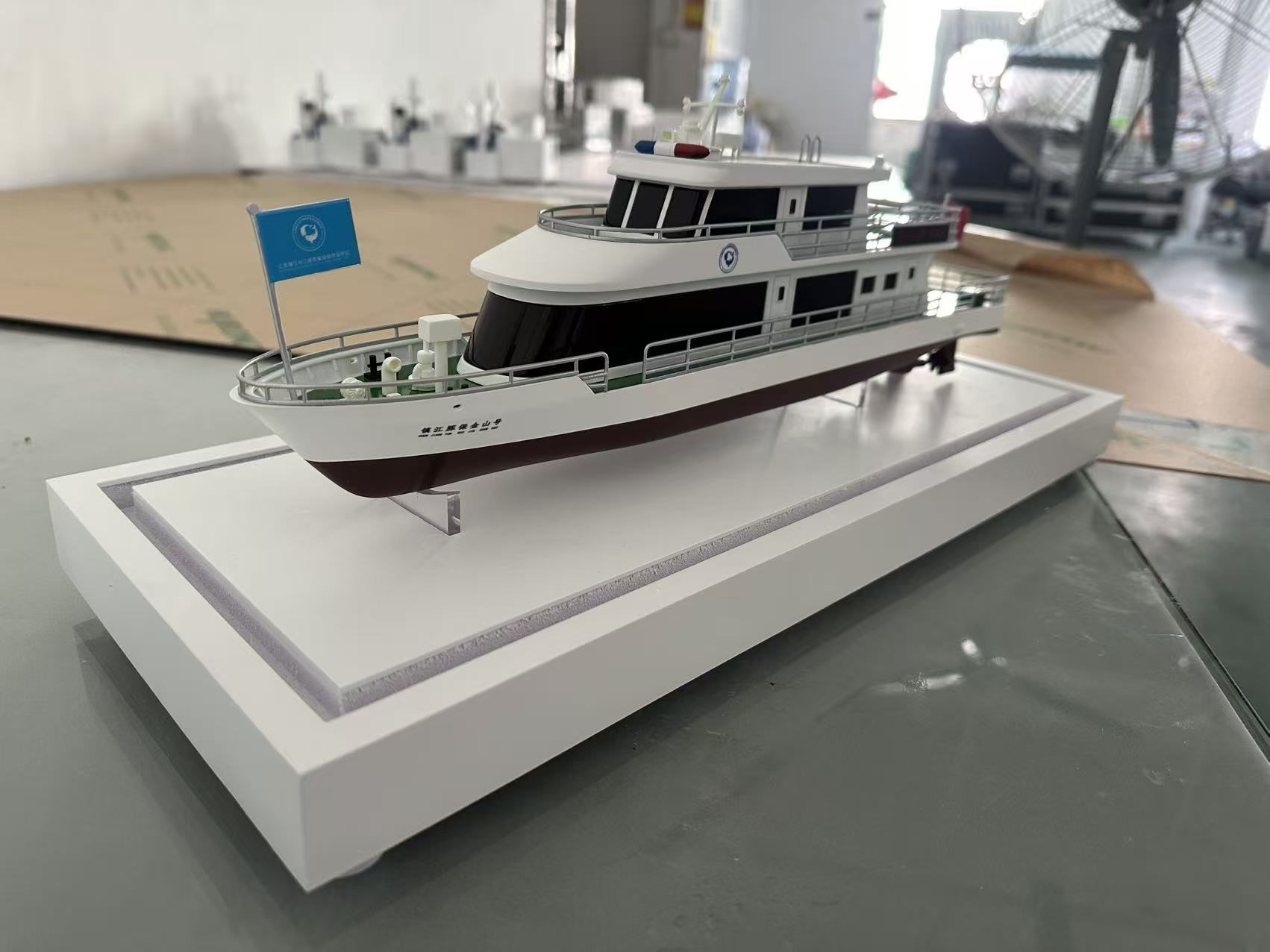
4、 Post processing and coloring: key steps to bring models to life
Primer and pretreatment: All component surfaces should be sprayed with white matte primer first, and then lightly sanded with 400 grit sandpaper after drying to ensure a smooth surface for subsequent coloring.
Layered coloring: The main body of the ship is coated with light gray acrylic pigment in three thin coats. After each coat dries, it is lightly sanded with fine sandpaper to simulate the texture of a real ship coating; The metal components such as window frames and railings of the superstructure are sprayed with silver metallic paint, and after drying, wiped with alcohol swabs to form a metallic luster; The anti-skid pattern on the bottom of the ship is partially painted with dark gray pigment to enhance its three-dimensional effect.
Special effect treatment: Spray transparent protective paint on the surface of the cab glass to avoid pigment adhesion; The bottom edge of the ship is dyed with light blue pigment to simulate the effect of a waterline; The stern propeller is coated with a combination of silver paint and white high gloss paint, restoring the metallic reflective texture.
5、 Assembly and Detail Adjustment: 90% Restoration Guarantee for "Closing"
After all components are completed, assemble them in the order of hull → deck → superstructure → mast, and fix key parts with detachable screws for easy maintenance in the later stage. After assembly, compare the photos of the actual ship, adjust the angle of the railing, the position of the lifebuoy, and other details to ensure consistency with the height of the actual ship shape. Finally, paste a blue flag on the edge of the base to complete the overall presentation.
6、 Finished product presentation: a "miniature version of the ship" that combines ornamental and collectible value
The overall restoration of the finished model reaches 90%, with smooth hull lines, distinct upper building layers, clear and visible deck details, realistic luster of metal components and glass transparency, and a simple and atmospheric base. Whether as industry representatives in corporate exhibition halls or as commemorative ornaments in personal collections, they can visually showcase the grandeur and delicacy of the rolling boat, allowing viewers to feel the visual impact of a "miniature version of the actual ship".


