
Analysis of the entire process of making Guangzhou Tower building gift models using photosensitive resin
Among the numerous architectural gift model productions, Guangzhou Tower has become an excellent object to showcase its manufacturing process due to its unique slender waist shape and mesh structure. The photosensitive resin 3D printing technology, with its high precision and excellent surface quality, has become the preferred solution for producing such landmark building models
Step 1: Digital Modeling and Structural Optimization
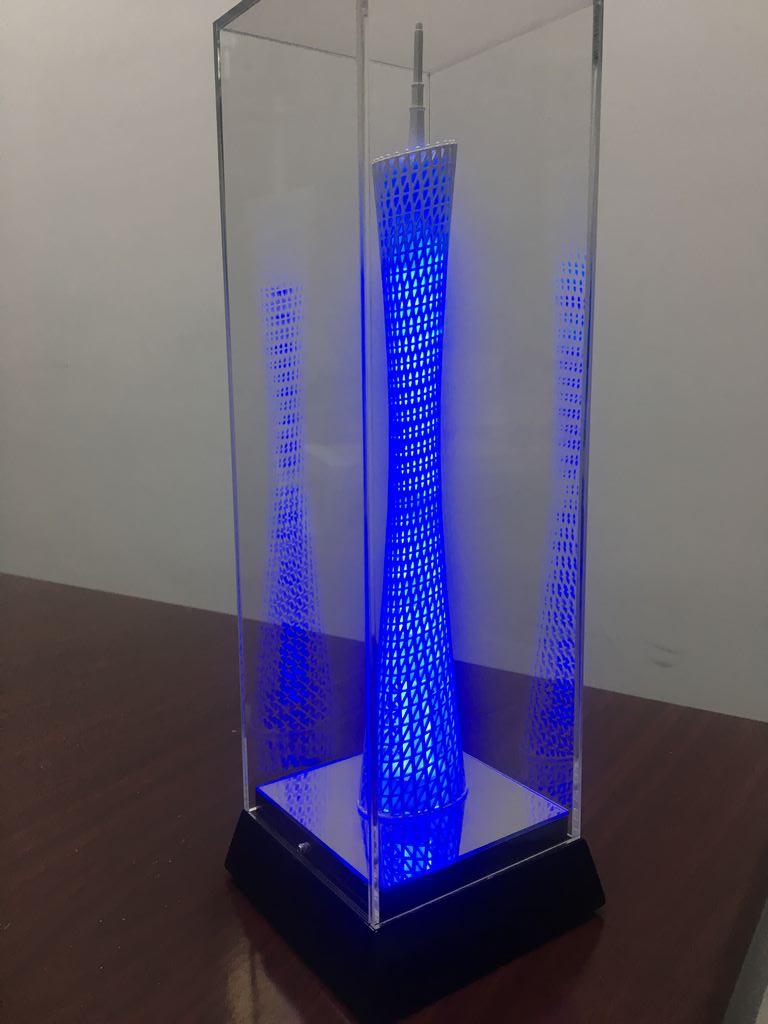
The production team first created an accurate 3D model of the Guangzhou Tower using computer-aided design (CAD) software. This stage requires special attention to several key points:
Detail restoration: Accurately reproduce the iconic mesh structure shell and slender waist shape of Guangzhou Tower, export the 3D model as an STL format file, which records the surface information of the model in the form of a triangular mesh
Support structure design: To prevent deformation or collapse of suspended parts during the printing process, specialized support structures need to be designed at the cantilever and isolated contour areas of the model
Step 2: Slicing and Parameter Setting
Import STL files into specialized slicing software, which will layer and decompose the 3D model into a series of 2D cross-sectional images
The key parameter settings for this stage include:
Layer thickness selection: usually set between 25-100 microns, the smaller the layer thickness, the smoother the model surface, but the printing time also increases accordingly
Filling density: Adjust the internal filling rate according to the structural strength requirements of the model, which can ensure strength and save materials
Supporting parameters: Fine adjust the density and contact point size of the supporting structure for easy removal in the later stage without leaving obvious traces
Step 3: Printing preparation and device debugging
Adequate equipment inspection and material preparation are required before formal printing:
Selection of photosensitive resin: Choose the appropriate resin type according to the model requirements, such as universal resin, high-strength resin, or high transparency resin. The main components of photosensitive resin include oligomers, reactive diluents, and photoinitiators
Equipment calibration: Check the output power and wavelength of ultraviolet lasers (such as helium cadmium lasers or argon ion lasers) to ensure accurate beam focusing and calibrate the levelness of the printing platform to ensure uniform curing of the first layer
Step 4: Layer by layer solidification printing process
After printing starts, the device starts working according to the preset program:
Platform positioning: The printing platform descends to a distance of one layer thickness above the bottom of the liquid tank, ensuring even coverage of the liquid photosensitive resin.
Laser scanning: The ultraviolet laser beam scans the surface of the resin based on the sliced data, triggering a photopolymerization reaction to transform the resin from liquid to solid
Layer by layer stacking: After completing the curing of each layer, the platform descends by a layer thickness distance, and new liquid resin covers it again. The laser continues to scan the next layer, repeating this process until the entire model is completed
Step 5: Support removal and post-processing
After printing, the model needs to go through a series of post-processing steps:
Support removal: Carefully peel off the support structure of the model to avoid damaging the main details
Cleaning treatment: Use specialized solvents such as isopropanol to clean the surface of the model and remove uncured resin residue
Secondary curing: Place the model in a UV curing box for post curing to enhance the mechanical properties and stability of the material
Surface finishing: Grinding, polishing, and even spraying transparent coatings as needed to enhance the glossiness and texture of the model
High precision machining techniques
For parts with extremely high dimensional accuracy requirements (such as the top antenna of Guangzhou Tower), composite technology can be used: based on the initial processing of photosensitive resin 3D printing, key parts can be precision processed by combining mechanical processing methods, achieving dimensional accuracy of 0.01mm or even higher
Conclusion
The production of Guangzhou Tower architectural gift models through photosensitive resin 2D printing technology is a perfect combination of modern manufacturing technology and traditional craftsmanship spirit. From digital modeling to the final product, every step needs to be carefully controlled in order to accurately showcase the charm and beauty of this modern architectural miracle within these miniature dimensions.
This production process is not only applicable to the Guangzhou Tower model, but also provides reference for the production of other complex architectural gift models, demonstrating the wide application prospects of photosensitive resin 3D printing technology in the field of high-end gift customization


